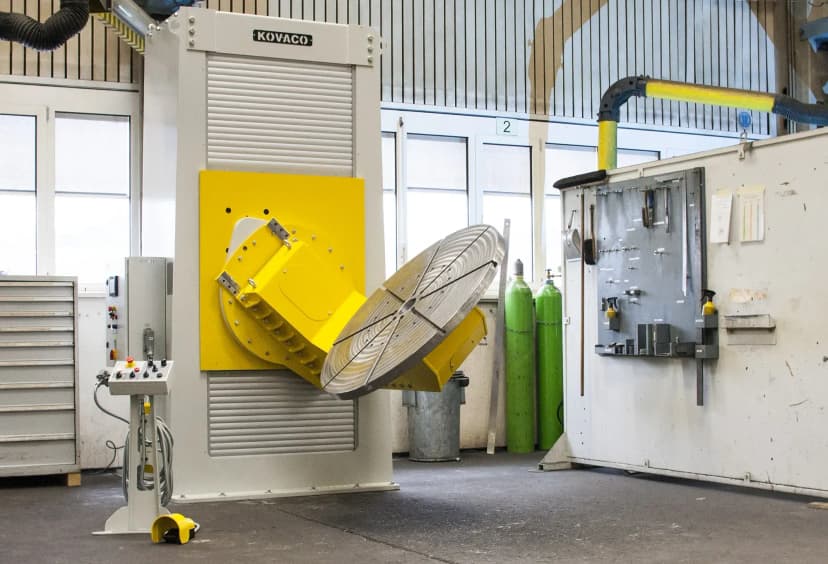
A welding positioner is bought for one reason: to turn the weldment so that every seam is welded in the flat or horizontal position. The choice comes down to four numbers that you can read from the drawing of your heaviest part. Get them right and almost any model in the range will do its job for twenty years; get one of them wrong and the machine will be either oversized and expensive or undersized and unsafe.
One: the mass of the weldment, including the fixture
Rated capacity is quoted for the complete load on the faceplate: the part, the clamping fixture, any counterweights and the adapter plate. A 1 200 kg frame with a 250 kg fixture is a 1 450 kg load. Add a margin for the next, heavier product you already know is coming; positioners are rarely replaced because they got old, but often because the parts grew.
Two: the position of the centre of gravity
Every rated capacity is tied to a distance of the centre of gravity from the faceplate (the overhang) and from the axis of rotation (the eccentricity). Manufacturers publish this as a load diagram: the further the centre of gravity moves away from the faceplate, the less mass the machine may carry, because the tilting moment on the bearing and the drive grows linearly with distance.
- Overhang: distance from the faceplate to the centre of gravity, along the rotation axis.
- Eccentricity: distance from the rotation axis to the centre of gravity, across it.
- Tilting moment: mass × overhang. This is the number the slewing ring and the tilt drive are sized for.
- Rotation torque: mass × eccentricity. This is what the rotation drive must overcome when the part is off-centre.
If your part is long and mounted at one end, the overhang decides the machine, not the mass. A 600 kg beam held 900 mm out can need a larger positioner than a compact 1 500 kg block.
Three: the tilt angle you actually need
Most seams are reached with a tilt of 0–90°. A positioner that tilts to 135° lets you weld the underside of a part without unclamping it, which matters for closed frames and boxes. Ask for the angle that lets the welder reach the last seam in the flat position, not for the largest angle in the catalogue.
Four: manual or robotic
A manual positioner is operated by the welder with a pendant or foot switch: rotation and tilt speeds are set for a person working next to the part. A robotic positioner is an axis of the welding cell: it needs a servo drive, an encoder and an interface to the robot controller, and the faceplate has to repeat its position to a fraction of a millimetre. The mechanical base can look the same; the drive and the electrics are different machines.
What to send us for a quotation
- The drawing or a photo of the heaviest and the longest part, with its mass.
- How the part is clamped today and how far the centre of gravity sits from the mounting face.
- Whether the welder works by hand or a robot does, and which robot controller.
- The floor: anchoring possible or not, and the space around the machine.
With these four answers an engineer can name the model and the fixture in one reply. That is what the inquiry form on this site is for.
Questions and answers
Does the rated capacity include the fixture?
Yes. The capacity is the complete load on the faceplate: part, fixture, adapter plate and counterweights. Size the positioner for the sum.
What if my part is light but very long?
Then the overhang decides. Multiply the mass by the distance of the centre of gravity from the faceplate and compare the result with the tilting moment in the load diagram, not with the plain capacity.
Can a manual positioner later be used with a robot?
Usually not without changing the drives and the control. A robotic positioner needs servo drives and an interface to the robot controller, so decide this before ordering.